Published by The New Angle on Feb 26, 2026
February 26th, 2026
The famous phrase from Paddington Bear is 'deepest, darkest Peru'. This is the origin of Paddington Bear. Well, what is the deepest darkest origin of the English people?
The deepest darkest origin is what is called the 'Yamnaya culture' (3300 BC). This was the origin of the Indo-Europeans. In the Pontic-Caspian Steppe, which is in modern day Ukraine, the English have their deepest darkest origin. These were Steppe lands containing vast plains of fertile grass, and the early Indo-Europeans were wanderers and herders across these lands; they travelled with four-wheeled carriages and revered their horses and cattle. They were semi-nomadic, riding on horse back across the plains like cowboys, living on something akin to the American Prairies. Single-person graves indicate a warrior elite buried with their goods, often including wagons, and a chiefdom-based patriarchal hierarchy. They herded cattle, sheep, and goat and rode and sometimes sacrificed their horses. Later, male-dominated migration west replaced local male lineages as they expanded into Western Europe, and Steppe peoples subsequently formed a significant portion of European ancestory. This increased the height of the people. Their diet included meat, milk, yoghurt, cheese, and possibly fermented beverages like mead, with limited agriculture. They fermented their diary to increase protein content and to make it last longer, and this led to them developing a tolerance for lactose. They had a warrior culture, and these single-person inhumation graves were called ' kurgans '; they scattered and stained these graves with an ochre powder.
Regarding their religion, they had a polytheistic cosmology. One key figure was Dyeus Pater or the 'Sky Father', associated with daylight, order, and heavens. Another was the Earth Mother called Dheghom, associated with fertility and land. The Dawn Goddess Hausos was also worshipped; as well as 'Divine Twins' often linked to horses and rescue motifs. Solar and lunar deities, Sawel and Menot, also played a role. Other elements include Storm or Thunder gods slaying serpents or dragons, symbolising chaos conquered by order. This was embodied by Thor in the Proto-Germanic branch, and Indra in the Hindu-Vedic branch. Their were also gods and goddesses for the veneration of fire, water, and animal spirits like "Soul of the Bull". The worship of fire has been presrved in Vedic traditions practiced to this day. Ancestor veneration was key to Yamnaya culture, and their was a strong belief in the afterlife hence burial with goods. Concepts of oaths, justice, and natural law were embodied by Ahuras deities, like Mithra for covenants and Mazda for wisdom. This pantheon of Indo-European gods influenced Greek, Norse, and Vedic Sanskrit mythology and religion, for example the sky father 'Dyeus Pater' became 'Jupiter' in Latin, 'Dyaus Pitar' in Sanskrit, and 'Zeus' in Ancient Greek. {Unlike Thor and Jupiter, Wotan or Odin, the foremost Germanic god, does not have a clear link back to an Indo-European god. Wotan is from the Nordic Bronze Age expansion period, when a distinct Germanic culture was incubating, starting around 1700 BC. The old Proto-Germanic word is 'Wodanaz', which meant "Master of Ecstasy", "Lord of Frenzy", "Leader of the Possessed/Inspired", or "The Furious/Inspired One". Hence, Wotan appears to be a Proto-Germanic innovation.}
The Indo-Europeans also left their mark in language after they expanded into Europe. The Indo-European language group, and by extension the shared people, genetics, and culture, includes Irish gaelic, English, German, Latin, Greek, and Sanskrit. It does not include Semitic or Uralic (Finnish and Hungarian) languages. As an example of shared Indo-European roots, 'mother' in English is 'mathair' in Irish Celtic, 'mam' in Welsh Celtic, 'Mutter' in German, 'meter' in Ancient Greek, 'mata' in Indo-Iranian Sanskrit, and 'mater' in Latin.
Genetically, Western Steppe Herder ancestory is most potent in northern and eastern Europe at 40-50% today. Baltics and Nordics often have the highest, as well as Scots, Irish, and Icelanders. It is low in southern Europeans, 20-30% in Italians or Greeks and in some regions even lower. Amongst South Asians it is present but much lower; i.e. in the Italian range. Typically it is 10-30% on average across South Asia. North Indians often have 20-30% Yamnaya heritage (especially Indo-Aryan speakers, upper castes like Brahmins, Bhumihars, Ror, Jat, and some Punjabi/Pakistani groups). Priestly or warrior, male-inputted, sources often shows higher ancestory. On average in India probably 10-15%. So the Vedic/Hindu religion is showing a strong resemblance to the original Indo-European cosmology, but on average Yamnaya-heritage in India is similar to south European levels, and significantly lower in South India.
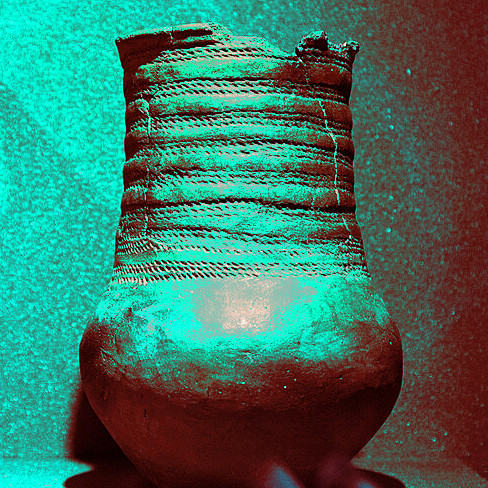
Onwards, these Steppe people migrated west and north to modern Germany, Poland, Scandanavia, and the Baltics in 2900 BC and admixed with local Neolithic farmers (70% Yamnaya + 30% local Neolithic), forming a distinct off-shoot culture called the 'Corded Ware Culture' (CWC), as distinguished by a style of pottery imprinted by cords found in the archeological record.
Then, from the modern Low Countries, a branch split of from CWC forming a distinct 'Bell-Beaker Culture' (BBC) which expanded westwards in 2600 BC. This is distinguished in the archeological record by a distinct bell-shaped pottery. These BBC people migrated to the British Isles in around 2500 BC, and discovered in Devon and Cornwall tin, and thus kick started the Bronze Age for Western Europe by advancing tin-copper metalworking and supplying Western Europe and the Mediterranean with this new metal. The tin-copper alloy was significantly harder and could be used for tools and daggers leading to significant advances in civilisation and social change. BBC people henceforth occupied much of Western Europe from 2600 BC, including all the British Isles from 2500 BC, distinct from their CWC origins.
The Nordic Bronze Age (NBA) began much later in old CWC lands (1700 BC), and expanded out of Scandanavia into Northern Germany and Netherlands over the next few centuries. This lay much of the cultural and linguistic groundwork of the Proto-Germanic branch of Indo-European. The NBA saw the incubation of a distinctly Germanic people out of the original CWC people. Meanwhile, in 800 BC a culture was crystallising in modern Hallstatt after the arrival of iron which had a distinct style which we can start to call 'Celtic'. This Hallstatt culture lasted 800-400 BC and spread across much of western Europe as a culture and in to Iron Age Britain.
Again, the old CWC territories were late to adopt the new iron innovations. When they did a unique 'Jastorf culture' (500 BC) developed out of the NBA in Northern Germany and Scandanavia, which we can first call 'Proto-Germanic'. Hence, there was something we can first identify as a Germanic culture in Northern Germany or Lower Saxony starting around 500 BC. This Germanic identity crystallised under Roman descriptions and narratives in the following centuries. Meanwhile, in Western Europe, stages of Celtic culture were developing, and Iron Age Britain (800 BC - 43 AD) was mirroring these Celtic developments. These were the Hallstatt period (800-400 BC), the La Tene period (400-100 BC), and finally the 'Oppida' period (100-43 AD). 'Celtic' was thus a culture and a lingua-franca spanning what the Romans called Gaul, Iberia, and Britain, and primarily amongst the BBC people. This includes the BBC people in Britain who had quickly almost completely replaced the old Neolithic farmers when they first arrived in 2500 BC. The Celtic BBC people in Britain lived throughout the Iron Age period until the Roman conquest of 43 AD, when they fell before the yoke of Rome. In the latter stages of the Roman Empire, these people were Christian, whilst the Anglo-Saxons in North Germany were still heathen.
Meanwhile, towards the end of the Roman Empire in the fifth century, the Roman legions now consisted of almost entirely Germanic recruits. This lead to some Romanisation of the Germanic peoples, but they kept their pagan practices. Saxons from the Elbe-Weser triangle in Lower Saxony had been recruited to the regiments and somewhat Romanised, as were the Angles from lower Jutland, for example in the 'Anglevarii' regiment. These Angles and Saxons and Jutes started migrating to Britain after the Romans left a power vaccuum where they had withdrawn. Picts and Scots were attacking the Romanised-Britons (who were old Celtic BBC peoples, and now Christian). It seems they had forgotten how to fight, and had grown luxorious and complacent under the Roman yoke. Hence they hired the Anglo-Saxons, who had a reputation as well-established Romanised mercenaries from the continent. The rest is history.
In summary, the deepest darkest origins of the English are as follows: Yamnaya culture (3300 BC) in the Steppes, to Corded Ware Culture in N. Germany and Scandanavia (2900 BC), to early Germanic incubation under Nordic Bronze Age expansion (1700 BC), to a distinctly German Jastorf culture (500 BC), where Proto-Germanic takes form culturally and linguistically, to Angle and Saxon and Jutish legionaries migrating to Britain (400-500 BC), to the Anglo-Saxon Heptarchy, to the progenitor of the English state, Alfred the Great, in Wessex. Henceforth, the Germanic basis of Old English, and origins laid for 'Odin's day' (Wednesday), 'Thor's day' (Thursday), and 'Eostre' (Easter). Indeed, Alfred the Great had claimed to be a direct descendent of Odin. Subsequently, the now Christian Kingdom of Wessex was honed against the pagan Viking axe and expanded, until a unified English state formed under Alfred's grandson, King Aethelstan, in 972 AD.
Thus hail the English.