Published by The New Angle on Feb 25, 2026
February 25th, 2026
Split down the centre of the British Island are the Pennines. The Pennines are an upland region, covered with moorland. The southern part of the Pennines is called the Peak District. This separates Lancashire and Cheshire to the west, from Yorkshire and Derbyshire to the east, like a great spine down the centre of England.
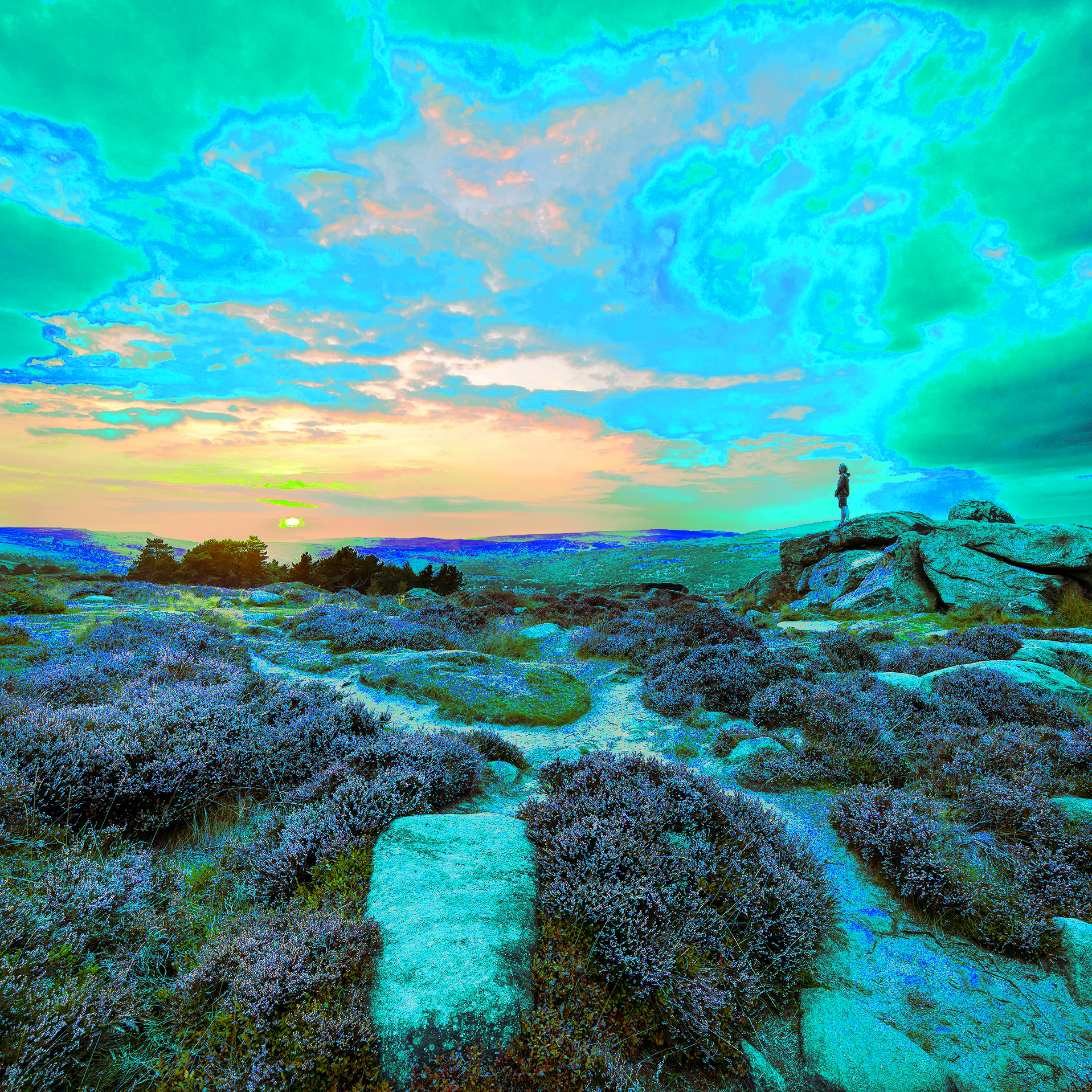
This upland region is barren and vast, with long, rolling moorland, and an infinite sky overhead. Covered with long, mud-yellow grass that thrushes in the cold and rough wind. You can take the so called 'Snake Pass' over the hills, from Manchester to Sheffield. The road winds down into dense forests of tall spruce. It follows the curving outline of large and still lakes. It is worthy of any car journey.
At times great swathes of purple heather break through the mild-coloured moor. Interesting creatures live amongst the grass. In Winter, the vast and empty land is painted white with snow. You drive along the road with the gloomy cloud overhead. The sky is usually gloomy overhead. And rugged and roughly constructed timber fence posts stick upwards, thin pieces of wood, and tilt over in different directions, strung together with wire. They block the snow from reaching the road.
At night time, you can return travelling east to west, from Sheffield to Manchester, curving through the high valleys and through the emptiness and the purple heather and the occasional tunnels of spruce wood. Then suddenly you turn a corner and a million little shimmering yellow lights appear, and some great humming red lights above them. Manchester. It appears from out of no where as you exit the valley of the Peak District.
As if part of some great Roman legion, you stumble upon this vast flat plain of habitable land, and plan your settlement. And therein lies the centre, the old Roman fort of Manchester. Now, a growing crop of skyscrapers.
It has been oft noted that geographical boundaries lead to ethnic divisions, and can have significant impact on geopolitics. This is the basis of the popular book 'Prisoners of Geography' by Tim Marshall. Well, this flat region of land as scouted out from the Peak District was initially occupied by the Britons and later the Romano-Britons; and, as fantasised above, Manchester was founded by the Romans as a northern fortress, similar to the larger one in Chester. Then the Anglo-Saxons arrived in East Anglia and Kent, and they formed England, slowly spreading from east Britain to west Britain, and pushing the Romano-Britons, who had a Celtic and Christian culture, further and further west. It is only sensible to assume that, as Highlanders later preserved their distilled Scottish character in the mountains, that upland regions of England were also harder for the Romans and Saxons to penetrate, and that western regions took longer to settle. Thus, upland regions and the west of Britain maintained the older people and their character for much longer. Indeed, the Romans thought it a waste of resources to venture into the Highlands against the Picts and Scots. Likewise in the Pennines, or the Peak District as the southern end is known. With a kind of geographical barrier, shielding off the area we call Lancashire and Cumbria, the old Romano-Britons and Celtic culture lasted longer amongst these upland moors and in the west. It is still palpable to this day. In the upland hills of Derbyshire, the Peak District, the Lake District, the Yorkshire Dales especially, it is safe to assume that this it true. In Lancashire and Cumbria also it is safe to assume this is true. This fact is recognised by reputable historians; that Lancashire and Cumbria maintain a semblance of Celtic culture and genetics. The Scots and Irish, with their keen ability to recognise their own, will probably tell you as much themselves, and can probably explain better why these people are Celtic in character. Indeed, there are some Celtic placenames in Lancashire, like Pendle, and many in Cumbria, like Helvelynn, Derwent, and Blencathra.
Thus, the powerful heath of the Peak District once formed a boundary between peoples and ages. As seen throughout history, geographical boundaries like these can lead to long lasting cultural distinctions. We hold that Lancashire, Cumbria, and the Pennines, have kept a degree of the old Brythonic variation of Celtic culture and genetics well into the present era.